
What's an ESOP?

An M&A Alternative with Broad-Based Benefits

What is an employee stock ownership plan? At its core, an ESOP is an ERISA-authorized retirement plan that invests in employer securities. Company stock is either issued or sold to an employee trust.

As a result, ESOPs enable closely-held companies to sell equity, at an independent valuation, to an employee trust. For middle-market firms seeking alternatives to third-party and private equity sales, employee stock ownership plans offer powerful business transition strategies.

These defined contribution plans also offer meaningful wealth-building opportunities for participants, tax advantages for all stakeholders, and continued autonomy for family-owned and private businesses.

Read ahead for answers to ESOP FAQs.

Embodying Conscious Capitalism

Employee ownership is not a handout. The benefits are meaningful, but the opportunities are earned.

Eligible staff are allocated stock over time, and those shares are subject to vesting. In the long run, employee owners gain skin in the game and wealth-building opportunities.

This helps foster "ownership cultures" that can propel businesses and their communities to new heights. Research has shown that employee owners and their firms outperform their peers in terms of business metrics and standards of living.

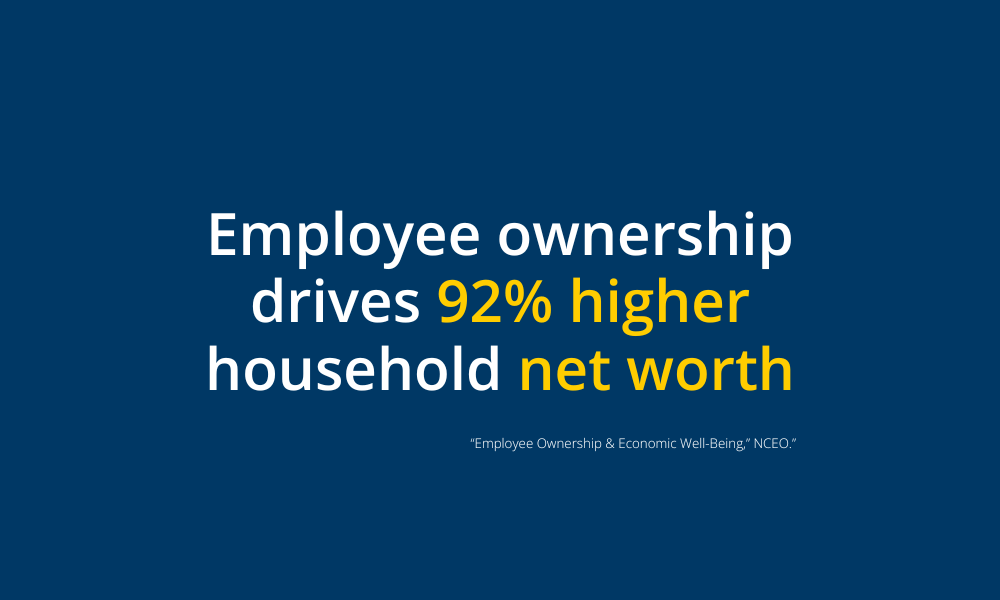
Employee ownership drives 92% higher household net worth

Employee Ownership Questions? We Can Help.


When CSG was founded in 2000, we made education a priority. That remains central to everything we do. So, if you have questions about forming an ESOP or operating an employee-owned company, you've come to the right place.

Look below for answers to frequently asked questions.

Who benefits from an employee stock ownership plan?

All stakeholders can benefit from a well-crafted employee stock ownership plan (ESOP). Selling shareholders receive fair market value for their equity, employees earn retirement benefits, and companies receive income tax incentives. On average, employee-owned companies are more productive, better positioned to attract and retain talent, and drive outsized benefits to their local communities, according to extensive ESOP impact research.

How do ESOPs purchase company stock?

An employee stock ownership trust (ESOT) acquires shares on behalf of ESOP participants. Employee owners do not pay out of pocket for stock. Instead, the sponsor company secures financing and repays those loans on the ESOT's behalf. A trustee negotiates the purchase price using an independent valuation.

Are partial ESOP sales permitted?

Yes. Also known as minority ESOPs, these transactions enable targeted shareholder exits and partial liquidity events. Sponsor companies retain the freedom to explore various transaction options, while individual shareholders can retain non-ESOP equity. Additional shares can be sold to the company's employee stock ownership trust at a later date.

How can ESOP sales deliver cash at close?

Third-party ESOP financing is commonly used to provide upfront cash to selling shareholders. Many lenders, including major banks and credit funds, help finance employee stock ownership plan transactions. These loans are secured by plan sponsors on behalf of their employee trusts. Seller notes are also a standard component of ESOP financing.

How is an employee stock ownership plan formed?

Employee stock ownership plans (ESOPs) are established through structured transactions that resemble other investment banking processes. After understanding a company's goals, finances, and ownership objectives, an ESOP advisor works with company stakeholders to conduct a feasibility analysis, structure a stock sale or contribution to an employee trust, secure financing, negotiate terms with a plan trustee, and finalize a plan formation.

Quick Reference Guide

Need an ESOP refresher? Download our guide for a concise overview of the mechanics and benefits of employee stock ownership plans.


CTA

Evaluating Employee Stock Ownership Plans


Leveraged ESOP sales carry notable advantages compared to private equity and third-party transactions. These versatile strategies are industry-agnostic, applicable to various use cases, and can be utilized by partnerships as well as C and S corporations.

But it's important to understand the full range of costs, benefits, corporate implications, and common use cases.

If you own or advise a private company and you're considering a transaction, it's also wise to compare employee stock ownership plans versus other M&A options.